Advice from an Expert on Deepfakes
I was invited to speak at the International Symposium on Synthetic Media Attribution and Detection (ISSMAD) 2026, co-sponsored by the IEEE and Google, and held at Google's offices in Mountain View, Calif., an industry panel on deepfake detection in real-time communications. Aptly, many of the questions I'd be asked would be forward-looking.
2026 marks the 10-year anniversary of when I first began tackling the problem of voice authentication and fraud detection in enterprise call centers and what would later be termed deepfakes.
Speaking at the ISSMAD panel seemed a meaningful opportunity to reflect on all that's changed in 10 years and assess the relevance of voice security technologies in the age of generative artificial intelligence, today and in the future.
No recording or transcript of the session exists, so here is my best attempt at recreating the discussion.
Q1 – Having led audio deepfake detection research at Microsoft and Nuance, what's the biggest gap you saw between what the research community measures and what actually matters in deployment?
It's not so much what's measured, but how it's being measured. And fundamentally it comes down to the data being used. We saw a few years ago that the training and benchmark datasets used in the scientific community to develop deepfake detection models were unrealistic at best and had dangerous gaps that allowed for shortcut learning at worst.
There's been some work since then to improve matters, to recognize that when a fraudster is actually going to use a deepfake recording on the phone it introduces a variety of artifacts due to codecs, channel noise, and other things.
But one of the main reasons datasets weren't up to the task was simply due to lack of resources. Deepfakes used to be primarily a theoretical, academic problem. Well now they've landed in the real world, so hopefully we see more investment into quality datasets to allow the community to build better countermeasures.
Q2 – Is generalization to unseen generators a solvable research problem or are we locked into perpetual retraining? What's the most promising path — artifacts, physiology, semantics, or something else?
For the second part of the question, I won't give a prescriptive answer. Many approaches are viable, and probably the best approach is a combination of all of those things.
But when thinking about the generalization problem, I always like to return to the signal itself. If your input signal is a piece of audio, the question fundamentally becomes "Is there something here that would allow us to differentiate a synthetic/deepfake voice from a real one?"
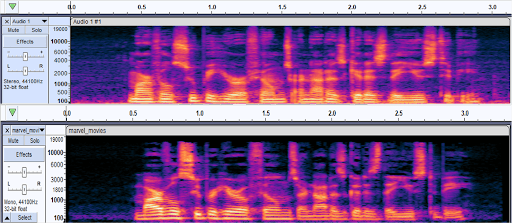
With the same phrase spoken by a person and an AI voice clone, you wouldn't be able to tell by listening, but the signal reveals differences between the human (top) and deepfake (bottom)
The answer has been yes for the past 10 years, and, to the best of my knowledge, remains yes today. As for generalization, to an extent the answer is yes. As always in the world of probabilistic technologies, and recalling that deepfake detection is a moving target problem, there cannot be any guarantees.
We've seen, however, that once you build a robust R&D program that includes a collection of rich and realistic datasets, ones that span as many of the known voice synthesis technologies available today, generalization is achievable (within reason).
I remember when a couple of years ago OpenAI first released its Voice Engine, there were (unbacked) comments along the lines of how this will defeat any voice recognition technology. We got our hands on some samples of the audio, and, while the voices sounded fantastic to the human ear, we found them relatively easy to detect by our deepfake detection models, even though we hadn't seen the data before.
This was possible because OpenAI likely used similar components to other known AI voice tech available. So maybe our detector wasn't working at 95 percent on this new AI voice on day 1, but we were at about 70 percent to 75 percent. And of course, at that point, any time you come across a new AI voice model you want to ensure your system learns those new characteristics to bring your performance back up to where you'd like it to be.
Q3 – Since traditional speaker verification is defeated by cloned voices, how should deepfake detection, liveness, and speaker verification be fused?
Again here, several options are possible, but the answer is indeed that you will want to do all of those things at the same time. Recall that anytime I'm faced with a voice security problem, I like to think about the audio signal. If we accept that the signal still gives us enough clues to differentiate synthetic voices from natural ones, then you can build a voice authentication technology that is aware of deepfakes.
The following two subtle points here are worth highlighting:
- Voice authentication isn't totally defeated by deepfakes, but voice authentication that is not built with awareness of deepfakes is defeated by deepfakes.
- Voice authentication uses the same signal as deepfake detection but is oriented toward a different goal. We've actually seen that voice authentication technology can help defend against deepfakes.
Q4 – We've begun seeing (and more to come) AI agents using voice to interact with call centers and individuals. How relevant does deepfake detection remain? What about other legitimate uses of AI voices, such as avatars?
I think of deepfake detection as a defense against malicious activity. Of course we will see AI voices become commonplace without any harm intended. In those scenarios, we'll need standards where any such use is announced somehow.
If you're talking to an AI voice, you should know it from the first moment (or earlier). We can even come up with ways to do this programmatically, whether it's through metadata attached to the media or phone call or through watermarks.
Otherwise, if a voice is identified at any point to have been AI-generated, and this wasn't properly announced or indicated, then you should assume malice and act accordingly. And for that reason, despite any other measures we come up with, we will always need tools to detect deepfakes.
Any parting words for the audience?
While I hinted at this earlier, I want to state generally that what fools the human ear does not necessarily fool the machine.
Often we're seeing that generative AI voice models are built using voice authentication models in their training loop to be able to make better voices.
There are alternatives to his approach, like using metrics based on mean opinion score (MOS) rather than biometric match. MOS-based metrics emphasize how things sound to the human ear, but this involves hiring people to label your data.
On the other hand, using voice authentication models is easy and cheap for genAI providers to do. But they're essentially building an adversarial technology to one of our defensive tools. So if you're a genAI provider building AI voices, maybe don't do that.